

CLARITY Act may stall, but crypto can grow: Bitwise
Bitwise Chief Investment Officer Matt Hougan said on Aug. 4 that the crypto industry would continue expanding even if the U.S. Senate fails to advance the CLARITY Act before its August recess.
Summary
- No CLARITY Act cloture motion appeared on Tuesday’s Senate schedule, narrowing this week’s remaining window.
- Bitwise’s Matt Hougan says SEC rulemaking could sustain crypto growth if Congress delays market structure.
- The bill cleared Senate Banking 15 to 9 but still needs sixty votes for cloture.
- Democratic senators seek ethics, consumer protection, illicit finance, conflict, and market integrity provisions before passage.
- Polymarket traders place 2026 enactment odds at 23%, reflecting doubts before the Senate recess begins.
In a new investor memo, Hougan said crypto “will be fine” without immediate congressional action. He argued that Securities and Exchange Commission rulemaking could provide an alternative path while traditional financial companies continue adopting digital assets. His assessment is a forward looking industry view, not a confirmed regulatory outcome.
The bill’s immediate prospects remain uncertain. The Senate’s Aug. 4 floor schedule did not include H.R. 3633, and the chamber’s official list of pending cloture motions named two unrelated matters. No cloture filing for the CLARITY Act had been announced by the end of Tuesday’s session.
CLARITY Act faces an Aug. 5 procedural test
Hougan identified Wednesday, Aug. 5, as the practical deadline for Senate leaders to file cloture and preserve a possible Friday procedural vote. Senate Rule XXII ordinarily requires a cloture vote one hour after the chamber meets on the following calendar day but one after filing. Sixteen senators must sign the motion.
Ending debate on legislation normally requires three fifths of senators duly chosen and sworn, or 60 votes when every seat is filled. The measure could move faster under a unanimous consent agreement, but such an arrangement would require cooperation that Senate leaders have not announced.
The Senate Banking Committee approved the bill 15 to 9 on May 14. Senator Cynthia Lummis later released a merged 616 page proposal combining work by the Banking and Agriculture committees. The revised measure remains on the Senate legislative calendar but has not received a full chamber vote.
As crypto.news reported on Aug. 4, government funding legislation and nominations occupied the available floor schedule. The omission does not legally kill the CLARITY Act, but it leaves little time for debate, amendments and a final vote before lawmakers depart.
SEC rules could help but cannot replace the bill
Hougan based his fallback scenario on comments from SEC Chair Paul Atkins, who said the agency was “ready, willing, and able” to address several matters covered by the legislation. Hougan believes rules adopted under Atkins could initially prove more favorable to innovation than compromises required for a bipartisan law. He said they “may even be an accelerant,” although no such effect is assured.
Atkins has supported agency action through Project Crypto, including work on token classifications, capital formation and securities market rules. However, he has also backed congressional legislation. In an official speech, Atkins said statutory language provides the strongest protection against future regulators reversing the current approach.
The distinction matters because the CLARITY Act would divide digital asset jurisdiction between the SEC and Commodity Futures Trading Commission. The updated congressional summary covers token disclosures, digital commodity exchanges, customer property, decentralized finance, stablecoin rewards and anti money laundering requirements.
The SEC can change rules governing securities, registered intermediaries and token offerings within its existing authority. It cannot independently grant the CFTC nationwide authority over digital commodity spot markets. SEC rules could therefore provide part of the framework, but not the complete structure Congress is considering.
As previously reported by crypto.news, agency rules would also be less durable than legislation. A future commission could revise or withdraw them through another regulatory process. A federal statute could only be changed through new congressional action.
Political disputes still threaten Senate support
Seven Democratic senators said on July 22 that the updated Republican text “falls short.” Catherine Cortez Masto, Angela Alsobrooks, Cory Booker, Ruben Gallego, John Hickenlooper, Mark Warner and Raphael Warnock requested stronger rules for elected officials, consumer protection, illicit finance, conflicts of interest and market integrity. They also said negotiations would continue.
The merged bill already contains an ethics division that would restrict covered officials and spouses from issuing or sponsoring digital assets for compensation while in office. It would also require additional financial disclosures. Democrats have not accepted those provisions as sufficient.
Banks are separately seeking tighter restrictions on rewards linked to payment stablecoin balances. The current proposal prohibits interest paid solely for holding stablecoins but allows certain activity and loyalty rewards. Banking groups argue that some exceptions could still resemble deposit interest and draw funds away from community lending.
Prediction markets have created another dispute. Twelve senators asked committee leaders to prevent CFTC registered platforms from listing contracts that resemble sports wagers or casino games. They also requested protections for state authority, tribal sovereignty and tribal gaming compacts.
These disagreements make the 60 vote threshold harder to reach. They also show why SEC action cannot resolve every issue. Questions involving CFTC powers, banking law, political ethics and tribal gaming require broader federal authority or additional legislation.
A delay would move the fight into a harder calendar
The Senate’s published calendar places lawmakers in a state work period from Aug. 10 through Sept. 11. Failure to act this week would not remove H.R. 3633 from the calendar, but it would push consideration into a period crowded by government funding, the November election and other unfinished legislation.
Hougan described that outcome as a “walking dead” period in which the bill remains alive without a clear route to passage. He suggested lawmakers could revisit it in September or attach provisions to a year end package. Those possibilities remain speculative because Senate leaders have announced neither a fall vote nor an omnibus strategy.
Polymarket traders currently give the CLARITY Act a 23% chance of becoming law by Dec. 31, down from 27% when Hougan published his memo. The market has attracted approximately $3.9 million in volume. Its price measures trader sentiment and is not an official congressional forecast.
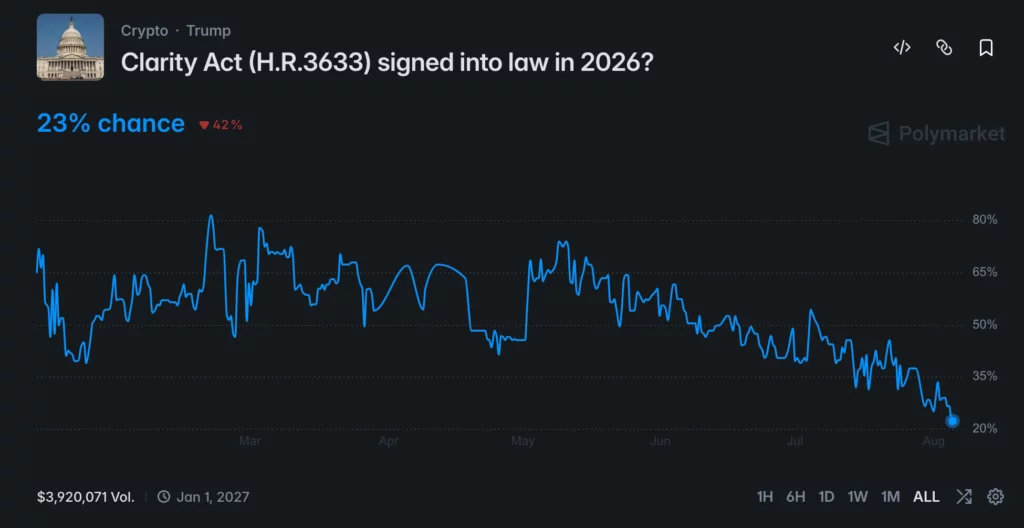
A cloture filing on Aug. 5 would be the next concrete development. Without one, ordinary Senate procedure would leave almost no route to a pre recess vote. The industry could still receive narrower SEC rules, but the long term allocation of U.S. digital asset oversight would remain unsettled.