

Bitcoin price drops below $63K despite Iran relief
Bitcoin slipped below $63,000 on Monday, Aug. 3, even as falling oil prices and stronger U.S. stock futures created a more favorable backdrop for risk assets.
Summary
- Bitcoin fell below $63,000 while oil and Treasury yields declined on renewed Iran diplomacy hopes.
- Coldcard attack estimates now exceed 1,815 BTC across more than 5,000 suspected victim addresses overall.
- Spot Bitcoin ETFs lost $61.53 million last week, ending three consecutive weeks of net inflows.
- Strategy added Bitcoin’s 200 week average as prices hovered only modestly above the indicator Monday.
- A Senate delay left the CLARITY Act without scheduled floor action before the August recess.
BTC traded near $62,556, down 1.38% over 24 hours and 4.35% over seven days. It had reached a Sunday high near $63,650 before sellers regained control. Ether fell about 1.8% to $1,841, while XRP and Solana also declined.
The weakness came as investors assessed renewed U.S. talks with Iran, another suspected Coldcard attack wave, fresh spot Bitcoin ETF outflows and the absence of the CLARITY Act from Monday’s Senate schedule.
Bitcoin price fails to follow the broader relief trade
President Donald Trump canceled a planned military strike on Iran and said negotiations would seek to address Iran’s nuclear program and reopen the Strait of Hormuz. Brent crude fell to about $83.28 per barrel, while West Texas Intermediate dropped to $79.47.
Nasdaq futures rose about 0.8%, while S&P 500 futures gained 0.6%. Treasury prices also strengthened as lower oil reduced some of the inflation concerns created by disrupted energy supplies.
Bitcoin did not follow that move. The divergence does not prove that one crypto event caused the decline. However, it shows that lower oil and stronger equity futures were not enough to overcome the pressures already affecting digital assets.
The relative weakness is consistent with a possible rotation of speculative capital toward technology stocks. Price action alone cannot confirm that movement, but renewed activity in equities can reduce demand for crypto when traders have several competing sources of volatility.
Coldcard losses keep security fears in focus
Galaxy Research head Alex Thorn identified what he described as a “LIKELY” fourth organized wave affecting Coldcard generated addresses. His updated estimate covered 709 potential victim addresses and 448.7 BTC. Activity reached 13.8 sweeps per Bitcoin block, about 45 times the rate measured during an earlier control period.
Galaxy had previously mapped three suspected waves involving 1,367.05 BTC across 4,585 addresses. Adding the latest estimate produces a possible total of 1,815.75 BTC across 5,294 addresses, assuming the groups contain no overlap.
That total remains an onchain estimate. Coinkite, law enforcement agencies and individual wallet owners have not independently confirmed every address as a victim. Galaxy has also not established whether one attacker controlled all four waves.
The incident concerns seed generation in affected Coldcard firmware rather than a failure in Bitcoin’s network or transaction cryptography. Coinkite said some devices created seeds with less randomness than intended, allowing attackers to search a smaller range of possible keys.
Coinkite has released corrected firmware for each affected model. However, installing an update does not repair an existing vulnerable seed. Users must generate a new seed with corrected firmware and transfer their funds. The company said its investigation remains ongoing.
As crypto.news previously reported, Thorn also identified similar transactions waiting in the mempool. Some users may be able to replace an unconfirmed attacker transaction with a higher fee transfer, although success is “not guaranteed.”
ETF outflows and the CLARITY delay add pressure
U.S. spot Bitcoin ETFs recorded about $61.5 million in net outflows from July 27 through July 31, based on SoSoValue data. The result ended three consecutive weeks of net inflows.
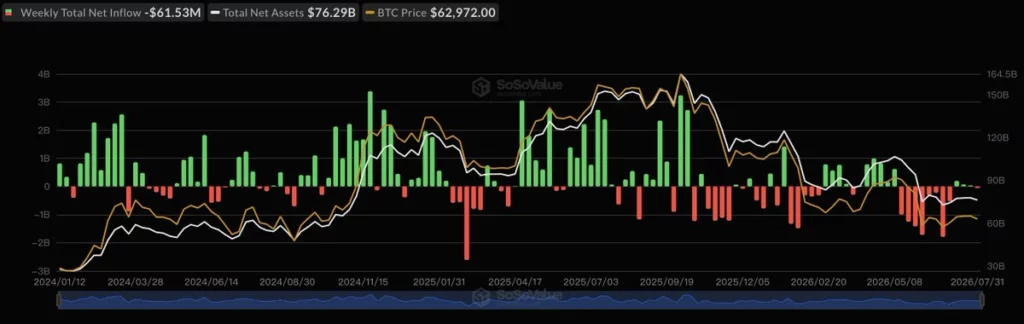
The final session caused most of the weekly reversal. Funds lost a combined $265.4 million on July 31. BlackRock’s IBIT recorded $122.7 million in withdrawals, while Fidelity’s FBTC lost $54.8 million and Grayscale’s GBTC posted $52.6 million in outflows.
The flows do not show whether investors expect further price declines. They do show that regulated fund demand weakened as Bitcoin moved closer to long term support.
Political uncertainty added another concern. Monday’s official Senate schedule included a vote on a spending measure but no action on the Digital Asset Market Clarity Act. The chamber’s published cloture records also showed no petition for the legislation.
As crypto.news reported, leaders would ordinarily need to file cloture by Wednesday, Aug. 5, to hold a possible Friday vote on proceeding to the bill. Such a vote would not constitute final passage.
The absence of scheduled action cannot be identified as the direct cause of Bitcoin’s decline. Still, it removes a possible near term policy catalyst while traders await a clearer Senate timetable.
Bitcoin price now faces a $60,000 support test
The supplied daily chart shows Bitcoin struggling below the $63,000 to $65,000 range. Momentum has weakened, with the relative strength index at 42.65 and below its moving average of 50.40.
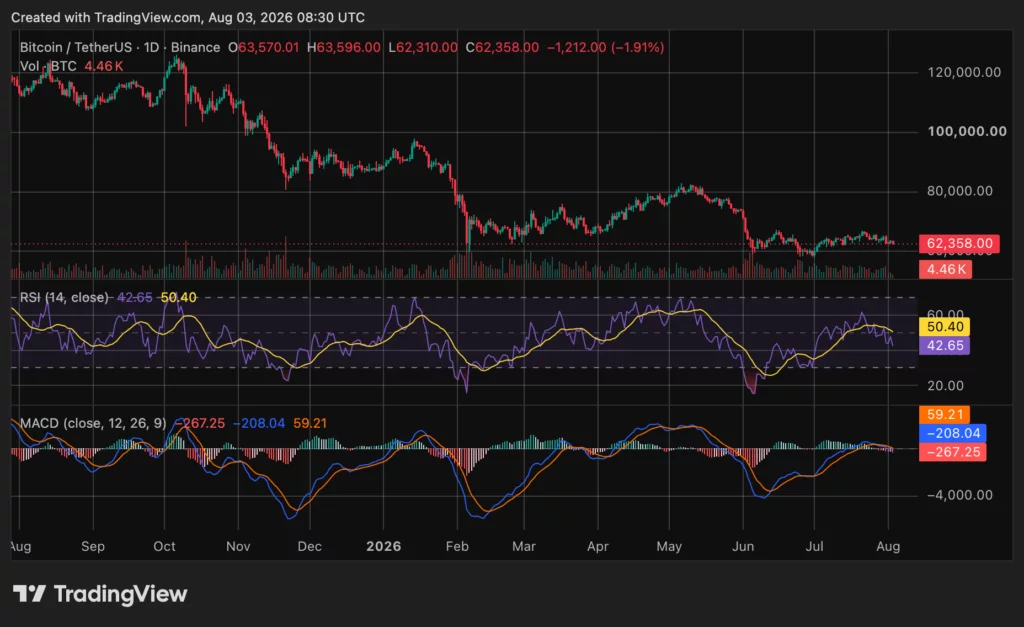
The MACD histogram has also turned negative. A sustained move below $60,000 would weaken the current structure, while a recovery above $65,000 to $66,000 would provide stronger evidence that buyers have regained control.
Strategy founder Michael Saylor said the company had begun tracking Bitcoin’s 200 week moving average and its premium to that level. He said Bitcoin had remained above the average 92% of the time since the indicator became available. The percentage reflects Strategy’s calculation rather than an independent market study.
The next checkpoints are Coldcard’s technical review, Monday’s ETF flows and any Senate filing before Wednesday. Until those pressures ease, lower oil prices and stronger stock futures may remain insufficient to produce a lasting Bitcoin rebound.
Disclosure: This article does not represent investment advice. The content and materials featured on this page are for educational purposes only.